 how-to
What to Use for Crappie in Texas: Gear & Techniques
Table of Contents
- Essential Gear for Crappie in Texas
- Best Crappie Jig Colors for Texas Waters
- Crappie Fishing Rigs for Beginners
- Live Bait vs. Artificial Lures
- Seasonal Crappie Fishing Patterns in Texas
- Structure and Sonar: Finding Crappie
- Vertical Jigging and Casting Techniques
- Common Mistakes to Avoid
- Frequently Asked Questions
Last Updated: October 2, 2026
Essential Gear for Crappie in Texas
When targeting crappie in Texas, your gear setup determines success. Whether you're fishing the Lower Laguna Madre's shallow bays or inland reservoirs, the right rod, reel, and line will land more fish. At Tubey's Outfitters, we've tested equipment in both saltwater and freshwater conditions across Texas waters.
Rod and Reel Setup
A 5.5 to 6.5-foot rod paired with a 1000 to 2000 series spinning reel is ideal for crappie. Light rods detect subtle bites and cast jigs accurately. Pair with smooth drag and reliable performance for all-day structure fishing.
Balance sensitivity with backbone, enough to set the hook but responsive in your hands. Smooth drag and comfortable grip matter for extended sessions.
Line Weight and Terminal Tackle
Use 4 to 6-pound monofilament in clear water, 8-pound in stained water with heavy structure. Fluorocarbon excels in clear water, it's nearly invisible and sinks faster, helping jigs reach the strike zone quicker.
Use 1/32 oz to 1/8 oz jig heads with 1/0 to 2/0 hooks for live minnows.
Best Crappie Jig Colors for Texas Waters
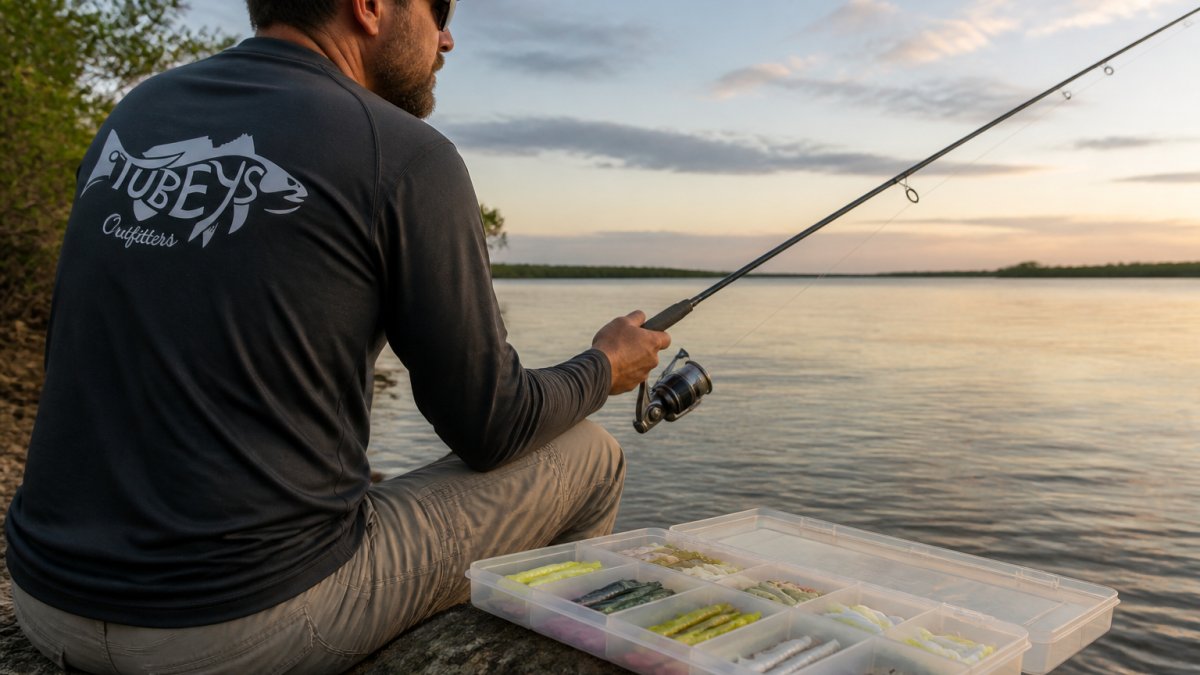
Color selection separates consistent catchers from occasional fishermen. Match jig color to water clarity and conditions.
Stained Water vs. Clear Water Colors
In stained water, crappie hunt by sight. Chartreuse, white, and orange create visibility and silhouettes crappie track. The Lower Laguna Madre and coastal bays benefit from high-contrast colors.
Clear inland lakes demand different thinking. Natural colors like shad patterns, pearl, and light green mimic the forage crappie actually eat. In clear water, crappie scrutinize your offering more carefully. Subtle color choices often outperform bright ones.
Seasonal Color Adjustments
Spring spawn: bright colors (white, chartreuse) trigger aggressive strikes. Summer: darker colors (black, brown) show up at depth. Fall: natural colors (shad, pearl) match forage changes. Winter: small dark jigs with slow presentations near structure.
Crappie Fishing Rigs for Beginners
Simple rigs catch more crappie than fancy ones. Focus on depth and confident presentation.
Simple Jig Head Setup
Tie a 1/16 oz or 1/8 oz jig head to your line with a 2 to 3-inch soft plastic shad. Cast near structure, count down to find depth, and work with subtle twitches. Crappie often bite on the fall. This approach works everywhere from Texas lakes to the Lower Laguna Madre.
Double Jig Rig and Slip Bobber Techniques
Double jig rigs cover two depths simultaneously, tie a second jig 18 to 24 inches above on a dropper knot. Slip bobber fishing works best in shallow water during spawn; set the bobber stop 1 to 2 feet above bottom for precise depth control.
Live Bait vs. Artificial Lures
Both live bait and artificial lures catch crappie. Success comes from understanding when each excels and combining them strategically.
Live Bait: When and Why It Works
Live minnows trigger aggressive responses, especially during spawn. In freshwater reservoirs, live shiners work year-round. In the Lower Laguna Madre and coastal bays, live mullet (2-3 inches) and shiners match native forage. Saltwater fishing demands heavier jig heads (1/8 oz to 3/16 oz) to handle tidal current.
Live bait advantages: natural scent, predatory triggers, effective during spawn. Disadvantages: requires aeration, dies in warm water, more expensive, harder to cast.
Artificial Lures: Consistency and Versatility
Soft plastics offer consistency, every cast presents the same profile and action. In stained water and the Lower Laguna Madre's tannin-stained bays, high-contrast colors (chartreuse, white, orange) create visibility live bait cannot match. Soft plastics excel in deep water and dense structure, maintaining action through dozens of casts.
Soft plastics advantages: consistent action, cost-effective, durable in structure, easy to cast. Disadvantages: lack scent, less effective in winter, require replacement when damaged.
Water Clarity Strategy: Matching Bait Type to Conditions
Clear water: natural colors (pearl, shad, light green) often outperform live bait. Stained water: both live bait and bright soft plastics work well. Live bait's scent dispersal is valuable; bright soft plastics create silhouettes crappie track visually.
Seasonal Bait Selection
Spring: live bait excels during spawn. Summer: soft plastics dominate, crappie suspend deep and live bait dies quickly. Fall: combine both approaches as water cools. Winter: soft plastics work best; crappie rarely chase moving prey.
The Combination Approach: Best of Both Worlds
Start with soft plastics to locate fish, then switch to live bait if crappie are finicky. In the Lower Laguna Madre, use bright soft plastic jigs to locate crappie in channels, then switch to live mullet or shiners if strikes slow. Master soft plastics first, then add live bait strategically.
Seasonal Crappie Fishing Patterns in Texas
Water temperature drives seasonal crappie movement. Understanding these patterns is crucial.
Spring Spawn and Early Summer
Spring spawn: crappie move shallow (3-8 feet) to shallow bays and creek channels. Target brush piles, standing timber, and fallen trees. Early summer: crappie move slightly deeper as water reaches the 70s, remaining accessible until the thermocline develops.
Summer Thermocline and Deep Structure
Mid-summer: crappie suspend around the thermocline (15-25 feet deep). Use a depth finder to locate this zone and vertical jig with subtle movements. In the Lower Laguna Madre, summer crappie move to deeper channels and bridge pilings as shallow bays warm.
Fall and Winter Transitions
Fall: crappie move from summer depths toward mid-range (8-15 feet) as water cools. Winter: crappie relate heavily to structure (brush piles, timber, pilings). Water in the 50s slows metabolism; use smaller jigs and slow presentations.
Structure and Sonar: Finding Crappie
Crappie relate to specific structure for food and shelter. Understanding how to identify and fish this structure, especially with modern electronics, separates consistent anglers from occasional fishermen.
Standing Timber and Bridge Pilings
Standing timber and bridge pilings hold crappie year-round in both freshwater and saltwater. In the Lower Laguna Madre, dock pilings, channel markers, and oyster reefs serve the same function. Cast parallel to structure to reduce snags. Fish shaded sides during bright days. Brush piles and oyster reefs are crappie magnets; fish just above and within them.
Using Electronics to Locate Crappie: Depth Finders and Modern Sonar
A quality depth finder is your best tool for finding crappie consistently. Modern units show bottom structure, vegetation, and fish arcs with precision. Learning to read these signals separates anglers who fish blind from those who fish smart.
Standard 2D Sonar Interpretation:
Crappie show up as small marks on traditional sonar. They're smaller than bass, so the arcs are subtle, typically 1 to 2 inches on your screen. Look for concentrations of marks near structure rather than isolated blips. A cluster of small arcs near a brush pile indicates a crappie school.
Vegetation shows as fuzzy, irregular areas on the screen. Crappie often suspend just above weed beds, using the vegetation as cover while staying in open water where they can feed. The boundary between vegetation and open water is a prime strike zone. In the Lower Laguna Madre, seagrass beds show similarly on sonar; crappie hold in the channels and edges adjacent to grass.
Brush piles appear as dense, irregular shapes, almost like a cloud or blob on your screen. These are crappie magnets. When you locate a brush pile, mark it and drop your jig directly into the pile. Crappie in brush piles bite aggressively because they're in a confined space with limited escape routes.
Bottom contour changes, drop-offs, ledges, and holes, concentrate crappie. A sudden depth change from 10 feet to 20 feet often holds fish, especially during summer and winter. Crappie use these transitions as feeding zones. Scan your sonar for these features and focus your casts there.
Forward-Facing and Side Imaging Sonar:
Forward-facing sonar (also called live sonar or real-time sonar) is a game-changer for crappie fishing. Units like Garmin Panoptix and Lowrance ActiveTarget show crappie in real time as they move toward and away from your jig. This technology reveals behavior that traditional sonar cannot.
With forward-facing sonar, you can watch crappie approach your jig. If a fish swims toward your lure and turns away, you'll see it happen. This feedback lets you adjust your presentation instantly, change jig color, speed, or position based on what the fish are actually doing. In clear freshwater lakes and the Lower Laguna Madre, forward-facing sonar shows crappie position relative to structure with stunning clarity.
Side imaging sonar creates a wide picture of the water column and bottom. It's excellent for scanning large areas quickly and identifying structure you might otherwise miss. A side imaging scan reveals brush piles, vegetation, and bottom composition across a 150+ foot swath. Use side imaging to locate promising areas, then switch to forward-facing sonar or traditional sonar to fish them precisely.
In the Lower Laguna Madre, side imaging reveals channel edges, shell structure, and grass bed boundaries that hold crappie. The shallow, clear water of coastal bays is ideal for sonar interpretation, you can see structure and fish behavior clearly.
Sonar Reading Tips:
- Small arcs (1-2 inches on screen) indicate crappie; larger arcs suggest bass or catfish
- Fuzzy areas show vegetation; crappie suspend just above or at the vegetation edge
- Dense, irregular shapes reveal brush piles; these are high-percentage targets
- Bottom contour changes (ledges, drop-offs) concentrate fish during transitions
- Forward-facing sonar shows real-time fish behavior; adjust presentation based on what you see
- Side imaging reveals structure across wide areas; use it for scouting, then zoom in with other sonar modes
Seasonal Sonar Adjustments:
Spring: Look for crappie in shallow water (3-8 feet) near structure. Your sonar will show fish suspended in brush piles and around timber. The arcs will be dense and concentrated because spawning fish gather in specific areas.
Summer: Crappie suspend around the thermocline, typically 15-25 feet deep. On sonar, you'll see a distinct layer of marks at a specific depth. This layer represents the thermocline zone where oxygen and temperature are optimal. Focus your jigging at this exact depth.
Fall: Crappie move from summer depths toward shallower water as water cools. Your sonar will show fish transitioning between 8 and 15 feet. Target the edges of structure during this period.
Winter: Crappie relate heavily to deep structure, holes, brush piles, and pilings at 15-25 feet. Sonar will show concentrated marks in these specific locations. Fish move less in winter, so pinpoint accuracy matters more.
Vertical Jigging and Casting Techniques
Presentation matters as much as location. How you work your jig determines strikes.
Vertical jigging dominates in deep water. Drop your jig to the bottom, then work it with short upward twitches. Pause between lifts. Crappie often bite during the pause.
This technique is deadly around bridge pilings and deep structure. The vertical approach keeps your jig in the strike zone longer. You're fishing with precision rather than covering water.
Casting works better in shallow water and around shallow structure. Cast near cover, let the jig sink, then retrieve with steady twitches. Vary your retrieve speed. Sometimes slow and steady wins. Other times, quick snaps trigger strikes.
In the Lower Laguna Madre, casting works well around shallow flats and structure. You're covering more water and hunting actively. This approach suits anglers who prefer a more dynamic presentation.
Technique selection:
- Vertical jigging: deep water, dense structure
- Casting: shallow water, scattered cover
- Mix both: adapt to conditions throughout the day
Common Mistakes to Avoid
Most anglers make the same errors repeatedly. Recognizing these mistakes saves time and improves your catch rate.
Using jigs that are too heavy. Heavy jigs sink fast but reduce sensitivity. You'll miss light bites. Stick with 1/32 oz to 1/8 oz jigs. These sizes work in almost all Texas conditions.
Ignoring water clarity. Bright colors work in stained water. Natural colors work in clear water. Matching color to conditions is non-negotiable.
Fishing too fast. Crappie are deliberate feeders. Slow your presentation. Patience catches more fish than speed.
Neglecting seasonal changes. Crappie move dramatically between seasons. What worked last month might fail today. Adjust your depth, structure focus, and presentation as seasons change.
Skipping the depth finder. Too many anglers fish blind. A depth finder reveals where crappie actually are. It's not cheating, it's smart fishing.
Using worn-out soft plastics. Torn or damaged plastics lose their effectiveness. Replace them frequently.
Crappie fishing in Texas rewards preparation and attention to detail. Match your gear to conditions, select colors that work in your water, and focus on structure where crappie actually live. Whether you're working the Lower Laguna Madre's coastal bays or inland reservoirs, these principles apply. Start with simple rigs, learn to read your depth finder, and adjust your approach as seasons change. The combination of proper equipment, smart color selection, and precise technique will fill your cooler. Get started with Tubey's Outfitters soft plastic lures and custom rods, gear designed and tested by anglers who fish Texas waters year-round, built to put more fish in the boat.
Frequently Asked Questions
What bait do crappie like best?
Live minnows are the top choice for crappie across Texas reservoirs and coastal waters. Small shiners, shad, and mullet work well depending on water clarity and season. Artificial soft plastics in natural colors mimic these forage fish and often outperform live bait in stained water. Many anglers find that combining live minnows under a slip bobber with jig presentations gives them the most flexibility to match what crappie are feeding on.
What month do crappie bite best in Texas?
Spring (March through May) is peak crappie season when fish move shallow to spawn. Fall (September through November) produces excellent bites as crappie feed heavily before winter. Winter can be productive in deeper structures and thermocline zones. Summer requires early morning and evening fishing near deeper cover and brush piles. Seasonal patterns vary between Texas reservoirs and coastal estuaries, so local knowledge and sonar help pinpoint active fish.
How do I choose between jig head weights for crappie?
Use 1/32 oz to 1/16 oz jig heads in shallow water (under 8 feet) and calm conditions for better sensitivity and natural presentation. Move to 1/8 oz when fishing deeper structure, strong current, or windy conditions. Heavier jig heads help you reach the strike zone faster when crappie suspend near thermoclines in summer. Match your jig weight to water depth and current, lighter presentations work better in clear water and tight cover like standing timber.
Can I use the same techniques for saltwater crappie in coastal areas?
Crappie in saltwater estuaries and inshore areas respond to similar jigs and soft plastics as freshwater crappie, but you may need to adjust colors for stained saltwater conditions and use slightly heavier tackle for stronger currents. Slip bobber rigs and vertical jigging work in both environments. Focus on bridge pilings, grass flats, and creek channels in coastal waters. Monofilament or fluorocarbon line handles saltwater conditions better than freshwater setups, and you'll want corrosion-resistant hardware on your rods and reels.