 how-to
Weedless Lure Rigging Step by Step: Saltwater & Freshwater
Table of Contents
- Weedless Rigging Step by Step: What You Need Before You Start
- How to Rig a Soft Plastic Lure Weedless: The Core Method
- Choosing the Right Weedless Hook for Soft Plastics
- Weedless Paddle Tail Rig: Matching Hook Size to Bait Size
- Weedless Rig for Redfish and Speckled Trout in the Lower Laguna Madre
- Rig Selection by Cover, Depth, and Fall Rate
- Common Weedless Rigging Mistakes and How to Fix Them
- Hook-Up Performance: Setting the Hook on a Weedless Rig
- Frequently Asked Questions
Last Updated: October 9, 2026
Weedless Rigging Step by Step: What You Need Before You Start
Weedless lure rigging step by step comes down to one skill: burying the hook point so it slides through grass, then setting it so it still grabs fish. Get that right and you can fish places other anglers skip. This guide from Tubey's Outfitters walks through the full process, from picking a hook to checking your bait before the cast.
Weedless rigging is the practice of rigging a soft plastic so the hook point sits hidden inside or against the bait, letting it pass through vegetation without snagging.
That matters most in shallow grass. In the Lower Laguna Madre, redfish and speckled trout sit tight against seagrass edges, and a bait that snags on every cast never reaches them.
Here's what most guides get wrong: they treat weedless rigging as one method. It's really a family of setups, and the right one changes with your cover, depth, and bait.
Below, we cover the core method, then how to adjust it for paddle tails, redfish, and deep water.
Hooks, Baits, and Tools for the Job
You don't need much tackle to rig weedless. A few basics cover most situations.
- Wide-gap worm hooks, sized 3/0 to 5/0 for most soft plastics
- Weighted swimbait hooks or jigheads for deeper water
- Soft plastic baits: paddle tails, tube baits, and straight worms
- Sharp braid scissors or line cutters
- Fishing line matched to your rod, plus a leader when fish are line-shy
- A knot you trust, tied fresh before each trip
Match your hook to your bait before you thread anything. A hook that's too small won't clear the bait on the hook set. Too large, and the bait tears on the first cast.
How to Rig a Soft Plastic Lure Weedless: The Core Method
Learning how to rig a soft plastic lure weedless takes about a minute once you've done it a few times. The goal is simple: the bait stays straight, the hook point stays hidden, and the hook still drives home when a fish eats.
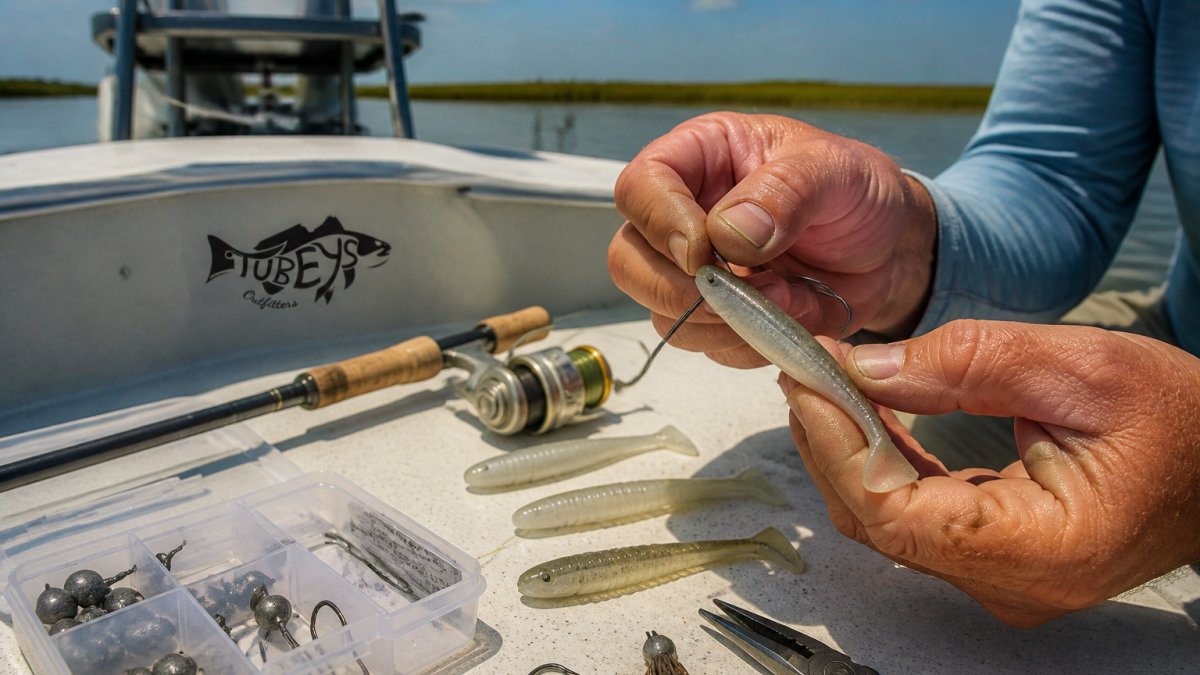
Step 1: Thread the Nose and Mark the Exit Point
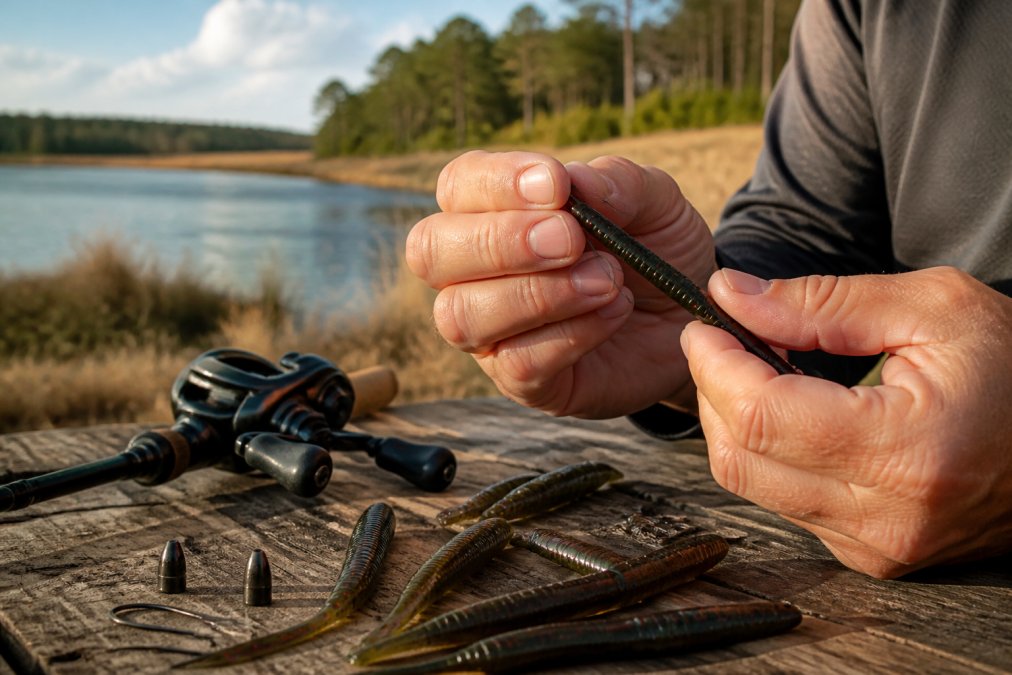
Start by pressing the hook point into the center of the bait's nose. Push it in a short distance, then bring it out the top.
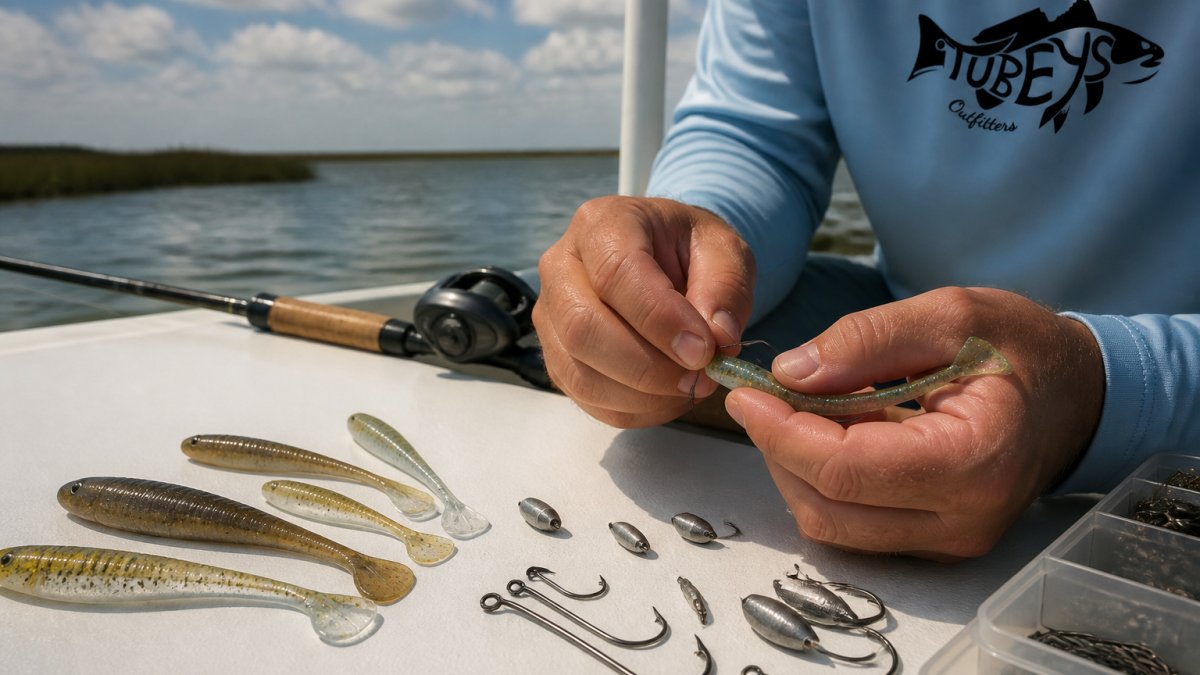
Now line up the bait against the hook shank. Lay the bait alongside the hook so the nose sits at the hook eye. Look at where the bend of the hook falls on the bait's body. That spot is your exit point. Mark it with your thumbnail.
This step decides everything else. Get the exit point wrong and the bait will bunch up or spin.
Step 2: Push Through, Bring Out, and Seat the Bait
Push the hook point through the nose and out at your marked spot. Slide the bait up the shank until the nose sits tight against the hook eye.
Then rotate the bait so it hangs straight. The hook gap should sit centered on the bait's back, not off to one side.
Check the bait from the side. If it curves, pull it off and start again. A curved bait won't track right in the water.
Step 3: Skin-Hook, Texpose, and Test for Straightness
This is where weedless happens. Two options:
- Skin-hook: push the hook point just under the surface of the bait's back. The point stays covered but breaks through easily.
- Texpose: push the point slightly through the top, then back it in a hair so only the tip shows. Better hook-up rate, slightly less weedless.
Test the bait by bending it gently. The hook should sit flat and the bait should hang straight. If the point pokes out too far, it'll grab grass. Too deep, and you'll miss fish.
Choosing the Right Weedless Hook for Soft Plastics
The best weedless hook for soft plastics is a wide-gap worm hook for most shallow cover, and a weighted swimbait hook when you need the bait to sink faster or cast farther. The wide gap is the key feature. It gives the bait room to collapse so the hook point can reach past it.
Hook styles and where they fit:
- Wide-gap worm hook: best for Texas-style rigging in grass and around wood
- Weighted swimbait hook: keeps a paddle tail tracking straight and adds casting distance
- Jighead: pairs with tube baits and smaller plastics in deeper water
- Offset shank hook: good for longer worms and straight baits
Match the hook size to the bait. A 3/0 fits most 4-inch plastics. Step up to 4/0 or 5/0 for bigger paddle tails and thick-bodied baits.
A common mistake is grabbing whatever hook is closest. Hook size and hook gap change how the bait sits, and a mismatched hook ruins the action.
Weedless Paddle Tail Rig: Matching Hook Size to Bait Size
A weedless paddle tail rig lives or dies on hook size and hook placement. Too small a gap, and the bait folds over the point on the set. Too large, and the tail won't kick, the bait tears at the nose, and the whole presentation rolls.
Start with the gap rule: the hook gap should be roughly twice the thickness of the bait's body at its widest point. That gives the plastic room to collapse when a fish crushes it, so the point can reach past the folded bait and into the jaw.
Use this as a starting chart, then adjust by feel:
| Bait Length | Body Thickness | Hook Size | Typical Use |
|---|---|---|---|
| 3 to 3.5 inches | Slim | 2/0 to 3/0 | Schoolie trout, small bass |
| 4 inches | Medium | 3/0 to 4/0 | Slot redfish, keeper trout |
| 5 inches | Medium to thick | 4/0 to 5/0 | Upper-slot redfish, big bass |
| 6 inches plus | Thick | 5/0 to 6/0 | Trophy-class fish, heavy grass |
Rigging Sequence for a Paddle Tail
- Align the bait on the hook before you thread anything. Lay the paddle tail alongside the hook so the nose sits at the eye. The bend of the hook should fall right where the bait starts to taper toward the tail. If the bend lands in the fat part of the body, size up.
- Mark the exit point with your thumbnail. That mark is where the hook point comes out of the top of the bait.
- Push the point through the nose and out at the mark. Slide the bait up the shank until the nose sits tight against the eye.
- Rotate the bait so the hook gap sits centered on the back. Look from the side. If the bait curves, pull it off and re-seat it. A curved paddle tail won't swim, it rolls, and fish won't commit.
- Skin-hook or texpose the point. For open water and sparse grass, texpose just the tip for a better hook-up rate. For thick seagrass, skin-hook it so the point sits flush under the plastic's surface.
- Check the tail. The paddle should hang straight off the back of the hook, not kinked to one side. A kinked tail kills the action.
Weightless vs. Weighted Paddle Tails
- Weightless: fish it slow over shallow grass. It sinks at a natural rate and stays in the strike zone longer. Best when fish are looking up in less than 3 feet of water.
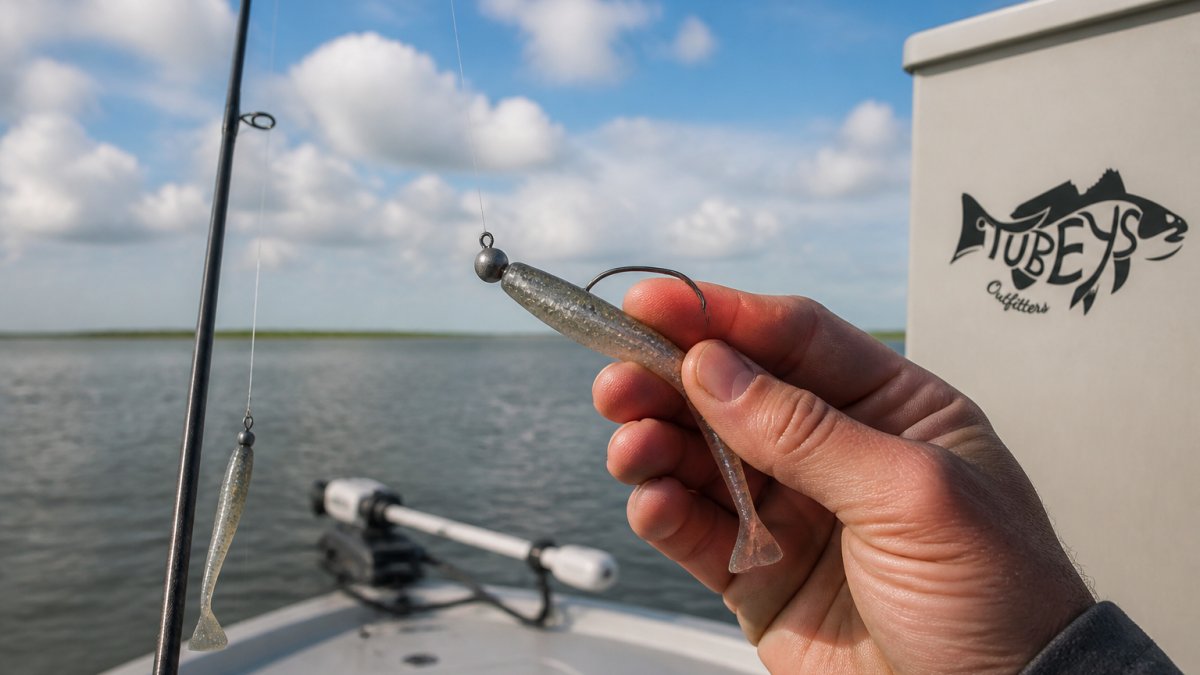
- Weighted swimbait hook: adds casting distance and a faster, more controlled fall. Use it along grass edges and over potholes where you need to cover water.
- Heavier jighead: for deep grass and drop-offs. Count the bait down to the strike zone instead of guessing.
Saltwater Application: Lower Laguna Madre
On the flats here, a 4-inch paddle tail on a 3/0 or 4/0 weighted swimbait hook is the workhorse. Redfish tailing over seagrass eat it on the fall. Speckled trout staged along grass-to-sand edges eat it on a steady retrieve.
Two adjustments matter on the coast:
- Match the bait color to the bottom. In clear water over light sand and grass, natural baitfish patterns out-fish dark colors. In off-color water after a blow, go darker so the bait silhouettes against the light.
- Slow the retrieve in cool water. Trout and redfish get lethargic when the water drops. A paddle tail crawled just fast enough to keep the tail ticking will out-fish a burned retrieve almost every time.
The same rigging sequence works in freshwater, a bass in hydrilla eats a paddle tail the same way a redfish eats one in seagrass. The cover changes, the mechanics don't.
Weedless Rig for Redfish and Speckled Trout in the Lower Laguna Madre
The Lower Laguna Madre is shallow, clear, and loaded with seagrass. That combination makes weedless rigging almost mandatory. A weedless rig for redfish here means a bait that slides over grass without hanging up, then drops into the potholes where fish feed.
We fish these rigs a few ways on the coast:
- Weightless Texas rig over shallow grass flats, worked slow
- Weighted swimbait hook for covering water along grass edges
- Jighead and tube bait when fish push into deeper potholes
Redfish tail on the flats, so watch for wakes and nervous bait. Speckled trout sit along the edges where grass meets sand. Cast past the fish and bring the bait back through the strike zone.
The same rigs work in freshwater too. A bass sitting in hydrilla or milfoil eats a weedless plastic the same way a redfish eats one in seagrass. The cover changes, the technique doesn't.
Rig Selection by Cover, Depth, and Fall Rate
Rig choice comes down to three things: what you're fishing through, how deep it is, and how fast you want the bait to fall. Fall rate is the part most anglers ignore, and it's often the difference between a bite and a follow.
Use this table to pick fast:
| Cover and Depth | Rig Choice | Fall Rate | Best For |
|---|---|---|---|
| Shallow grass, less than 3 feet | Weightless Texas rig | Slow | Redfish, bass |
| Grass edges, 3 to 6 feet | Weighted swimbait hook | Medium | Trout, bass |
| Potholes and drop-offs | Jighead and tube bait | Fast | Trout, redfish |
| Wood and docks | Wide-gap worm hook | Slow to medium | Bass |
| Deep grass, 8 feet plus | Heavier jighead | Fast | Trout, bass |
Start light and add weight only when you need it. A bait that falls too fast drops past fish that are looking up. A bait that falls too slow never reaches the strike zone.
Common Weedless Rigging Mistakes and How to Fix Them
Most rigging problems trace back to the same handful of errors. Here's how to spot them and fix them fast.
- Bait bunched at the nose: you pushed the hook too far before bringing it out. Pull the bait off and re-mark your exit point.
- Bait spins or rolls: the bait isn't straight on the shank. Slide it off and re-seat it centered.
- Hook point buried too deep: the point won't clear on the set. Skin-hook it lighter or texpose just the tip.
- Bait tears on the cast: hook is too large or the nose is split. Size down or start with a fresh bait.
- Missed hook sets: hook gap is too small for the bait. Step up a size so the bait can collapse.
Fix these before you cast, not after. Re-rigging takes ten seconds. Losing a fish you never hooked takes longer to get over.
Hook-Up Performance: Setting the Hook on a Weedless Rig
Hook-up performance on a weedless rig is a balance: the more weedless the bait, the harder it is to drive the point home. Every choice you make, hook exposure, hook style, line, rod, tips that balance one way or the other.
The Weedlessness vs. Penetration Trade-Off
- Texposed (point just breaking the surface): best hook-up rate, slightly less weedless. Use it in open water, sparse grass, and when fish are short-striking.
- Skin-hooked (point flush under the plastic): most weedless, but the point has to travel through the bait before it reaches the fish. Use it in thick seagrass and heavy cover.
- Buried deep: nearly snag-proof, but the point often never clears on the set. This is the most common cause of missed fish on a weedless rig.
A common pattern is to start texposed, then go more weedless as the cover gets thicker. If you're missing fish, expose more of the point before you change anything else.
Hook Style and Wire Strength
- Wide-gap worm hooks give the bait room to collapse so the point can reach past it. The wider the gap, the easier the bait folds out of the way on the set.
- Heavy-wire hooks hold up to big fish and heavy cover but take more force to drive home. Pair them with braid or a stiff rod.
- Light-wire hooks penetrate with less effort but bend out on big fish or shell. Match wire strength to the fish you expect, not the cover you're fishing.
Line, Rod, and the Set
Because the point is buried, you need to drive it through the bait and into the fish's mouth in one motion. That means:
- Low-stretch line (braid, or braid to a fluorocarbon leader) transfers more of your rod sweep into the hook. Mono stretches and softens the set.
- A rod with enough backbone to move the hook. A soft, parabolic rod loads up but doesn't drive the point. A fast-tip rod with a strong mid-section does both.
- A firm, sweeping set, not a violent overhead swing. Drop your rod tip, reel down until you feel weight, then sweep the rod to the side. That pulls the point through the plastic and into the jaw.
- Keep the line tight. Slack line lets the bait fold and the point miss.
Saltwater Hook-Set Notes
On the flats, redfish often eat a weedless plastic on the fall and turn with it. When you feel the tick, reel down and sweep, don't wait. Trout tend to slash and miss, so a slightly exposed point and a steady retrieve give you a better shot at a solid hook-up.
Shell bottom is hard on hook points. Run the point across your thumbnail after every few fish. If it doesn't bite, swap it. A rolled point won't penetrate no matter how hard you set.
Final Inspection Before the Cast
Run this checklist every time you re-rig:
- Bait hangs straight, no curve or kink
- Hook gap centered on the bait's back
- Point texposed or skin-hooked to match the cover
- Nose seated tight against the hook eye
- Hook point sharp enough to bite your thumbnail
- Knot fresh and tight
Ten seconds of inspection beats losing a fish you never hooked.
Frequently Asked Questions
How do you rig a soft plastic lure weedless?
Thread the hook eye into the bait's nose about 1/4 inch, push it through the body, and bring the point out at the top. Pull the hook eye back into the nose, then insert the point barely into the plastic to texpose it. The hook should sit straight along the bait's back. Test by dragging it through grass; if it snags, adjust the hook position.
What hook should you use for a weedless soft plastic?
Use an offset worm hook for slender baits like worms and flukes, or a weighted swimbait hook for paddle tails. Match the hook gap to the bait's body thickness, roughly double the width. For redfish and trout in grass, a 3/0 to 5/0 wide-gap hook works well.
Can you rig a paddle-tail lure weedless?
Yes. Use a weighted swimbait hook or a belly-weighted hook with a screw-lock keeper. Thread the nose onto the keeper, then run the hook through the body and texpose the point. Keep the bait straight so the tail swims true. This setup works in freshwater grass and saltwater flats.
How do you keep a weedless lure from snagging?
Keep the hook point just barely under the plastic's surface, not buried deep. Rig the bait straight so it tracks true. Use a weight that matches the cover; too light and the bait floats, too heavy and it digs in. After a few casts, check that the hook point hasn't pushed through. A properly texposed hook slides over grass and wood without catching.